A line cook reaches for product at the back of the walk-in cooler and notices it’s noticeably warmer than the shelf near the door. The thermostat reads normal. The compressor sounds fine. But something clearly isn’t right, because half the cooler feels colder than a walk-in freezer while the other half is barely holding temperature. This kind of uneven cooling is one of the most common issues Calgary restaurants and commercial kitchens run into, and more often than not, the cause is sitting quietly at the back of the unit: an evaporator fan that isn’t doing its job.
Unlike a compressor failure, which usually announces itself immediately with a total loss of cooling, evaporator fan problems tend to creep in gradually. That makes them easy to miss until the temperature swings start affecting food safety or product quality. This article explains what the evaporator fan actually does, what happens when it fails, the signs to watch for, and what’s usually involved in getting it fixed.
What the Evaporator Fan Actually Does
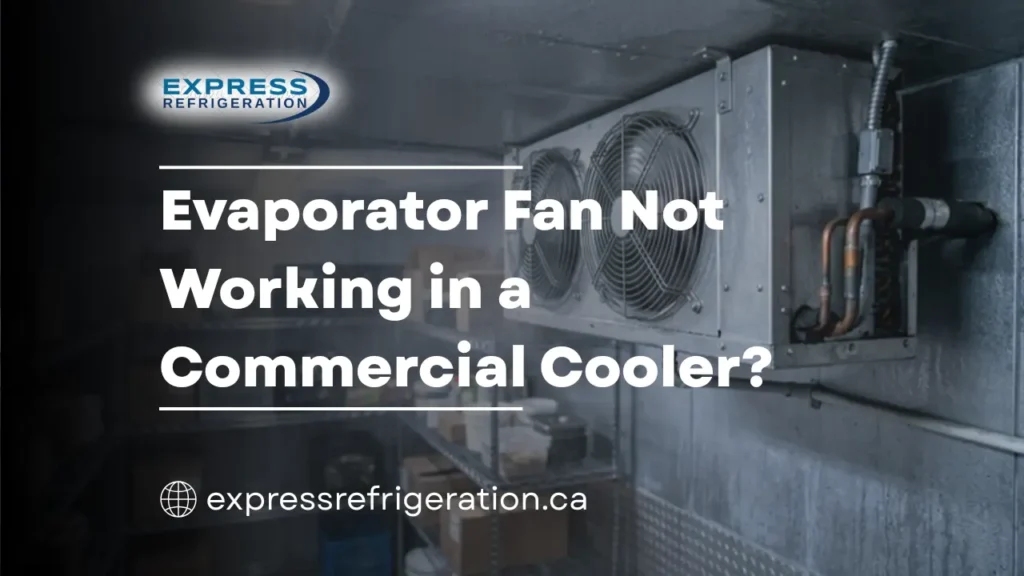
The evaporator fan sits inside the cooler, mounted near the evaporator coil, and its job is simple but essential: pull air across the cold coil and push it out through the unit to circulate cold air evenly throughout the space. Without that circulation, cooling becomes localized instead of even. The area right around the coil might get extremely cold while air further away barely moves at all.
This matters more than people often realize. A commercial cooler isn’t just about hitting a target temperature on a thermostat. It’s about maintaining consistent, food-safe temperatures across every shelf, every corner, and every product inside. That consistency depends entirely on proper air movement, and proper air movement depends on the evaporator fan running the way it’s supposed to.
What Happens When the Evaporator Fan Fails
Uneven Temperatures Throughout the Cooler
This is usually the first thing staff notice. Product near the coil stays properly cold or even starts to freeze, while product on the opposite side of the cooler or near the door sits several degrees warmer. Without circulation, cold air pools instead of distributing, and warmer air from door openings and kitchen activity doesn’t get properly displaced.
Warm Spots and Inconsistent Cooling
Beyond just uneven readings, a failing fan often leads to entire sections of the cooler running warmer than the thermostat setting suggests. This is a common source of confusion for kitchen managers, since the control panel might show a temperature that looks fine while product in the back corner is well above the safe range.
Ice Buildup Around the Coil
When air isn’t circulating properly, moisture tends to concentrate and freeze directly on and around the evaporator coil instead of being carried through the space. Restaurant owners frequently overlook this connection, assuming ice buildup is a defrost issue on its own, when in many cases it’s the fan failure that’s allowing frost to accumulate faster than the defrost cycle can clear it.
Noisy or Unusual Operation
A fan on its way out often makes noise before it stops completely. Grinding, rattling, buzzing, or a rhythmic clicking sound coming from inside the cooler are all signs worth taking seriously. Technicians often encounter units where staff had been hearing an odd noise for days or even weeks before calling for service, by which point the fan motor has usually failed entirely.
Rising Energy Use
A cooler working harder to compensate for poor air circulation tends to run longer cycles and consume more energy without actually achieving better cooling. This is easy to miss on a monthly basis but adds up over time, especially in Calgary kitchens running multiple refrigeration units around the clock.
Common Causes of Evaporator Fan Problems
Failed or Worn Fan Motor
Motors wear out from continuous use, and commercial coolers run their fans nearly non-stop. Bearing wear, winding failure, or a motor simply reaching the end of its service life are among the most frequent reasons a fan stops spinning altogether.
Damaged or Bent Fan Blades
Blades can crack, bend, or come loose from the motor shaft, especially if ice has built up around them and been forced or chipped away without proper care. A damaged blade can throw the whole fan off balance, leading to noise and reduced airflow even if the motor itself is still functioning.
Wiring and Electrical Faults
Loose connections, damaged wiring, or a failed capacitor can prevent a fan motor from starting or keep it running inconsistently. This is one of the reasons a fan that looks intact might still not be spinning, since the issue isn’t mechanical at all but electrical.
Control Board or Relay Issues
Some commercial cooler systems use a control board to manage fan operation alongside defrost cycles and compressor timing. A fault in that control logic can prevent the fan from receiving power at the right times, even when the motor and wiring are both in working condition.
Ice Interference
Heavy frost or ice accumulation around the fan blades, often the result of a separate defrost problem, can physically prevent the blades from turning. In these cases, the fan itself may be perfectly fine, but it’s frozen in place until the underlying ice issue is resolved.
How to Diagnose the Issue
A proper inspection usually involves:
- Visually checking the fan blades for damage, ice buildup, or obstruction
- Testing motor amperage draw against manufacturer specifications
- Checking wiring, connections, and capacitors for faults
- Reviewing control board function and defrost cycle timing
- Measuring temperatures at multiple points inside the cooler to confirm airflow patterns
- Inspecting the evaporator coil for related frost or ice issues
Professional inspections usually reveal that what seemed like a single fan problem is connected to a broader issue, whether that’s a defrost system fault or a door seal letting in excess moisture. Diagnosing the fan in isolation without checking the surrounding system can lead to a repair that doesn’t fully solve the problem.
Repair Options
Fan Motor Replacement
When the motor has failed or is drawing incorrect amperage, replacement is typically the most direct fix. Using a properly matched replacement motor is important for long-term reliability rather than a temporary workaround.
Blade Replacement or Balancing
Damaged blades can sometimes be replaced individually without needing a full motor swap, particularly on units where the blade and motor are separate serviceable components.
Wiring and Electrical Repair
If the issue traces back to a loose connection, damaged wire, or a failed capacitor, addressing that electrical fault directly can resolve the problem without replacing the fan at all.
Control Board Repair or Replacement
For units where a control board is preventing proper fan operation, repairing or replacing that component restores normal function across fan timing, defrost cycles, and overall system coordination.
Prevention Tips
- Address unusual fan noise as soon as it’s noticed rather than waiting for a full failure
- Keep shelving and product away from the fan and coil area to avoid physical damage during loading and unloading
- Schedule routine inspections that include fan operation checks, not just temperature readings
- Monitor for uneven cooling patterns and treat them as an early warning sign
- Have door gaskets and defrost systems checked regularly, since moisture and ice issues elsewhere in the system often affect fan performance
Cost Considerations
Evaporator fan motor replacement is generally one of the more contained repair costs in commercial refrigeration, particularly when caught early. The cost tends to rise when the problem has been left long enough to cause secondary issues, like heavy ice buildup damaging blades or extended warm temperatures putting product at risk. Addressing fan noise or uneven cooling promptly is almost always the more cost effective path compared to waiting for a complete breakdown.
When to Call a Professional Technician
If your commercial cooler has warm spots, ice buildup that keeps returning, unusual noise from inside the unit, or temperature readings that don’t match what you’re seeing on different shelves, it’s time to have the evaporator fan and surrounding system inspected. These issues rarely resolve on their own and tend to affect product quality and food safety the longer they’re left unaddressed.
Protect Your Product. Call Express Refrigeration Today.
An evaporator fan that isn’t working properly puts your entire cooler’s consistency at risk, even if the thermostat still looks fine at a glance. Warm spots, recurring ice buildup, and unusual fan noise are all signs that something mechanical needs attention, and delaying repairs can lead to spoiled product and food safety concerns.
Express Refrigeration helps Calgary restaurants, grocery stores, and commercial kitchens diagnose and repair walk-in cooler and freezer issues quickly, including evaporator fan motor, blade, wiring, and control problems. Our technicians check the whole system, not just the obvious symptom, so the repair actually solves the problem instead of masking it temporarily.
If your commercial cooler is showing signs of an evaporator fan issue, don’t wait for it to affect your inventory. Contact Express Refrigeration today to schedule a diagnostic visit and get consistent, reliable cooling back across your entire unit.