Running a food business in Calgary means staying ready for an Alberta Health Services inspection at any time. There’s no advance notice, no grace period, and no leniency for equipment that was “working fine last week.” Refrigeration is consistently one of the top areas where restaurants, delis, and commercial kitchens receive violations — not always because the equipment is broken, but because the documentation, food handling practices, or unit maintenance don’t meet the standards set out under Alberta Food Regulation AR 31/2006.
If you’ve ever had an inspector walk through your kitchen and flag your walk-in cooler or prep fridge, you know how quickly a single violation can escalate into a required reinspection — or worse, a conditional permit. This guide walks you through exactly what AHS inspectors look for when it comes to refrigeration, so you can get ahead of it before they show up.
What Alberta Health Services Inspectors Are Actually Looking For
AHS food safety inspectors follow a standardized evaluation process when assessing refrigeration in commercial food establishments. Their job is to verify that your equipment is capable of maintaining safe food temperatures and that your team is actively monitoring and documenting those temperatures.
Here’s a breakdown of the key areas they check.
The 4°C Cold-Holding Rule Under Alberta Food Regulation AR 31/2006
The most fundamental refrigeration requirement under Alberta’s food safety legislation is straightforward: all potentially hazardous foods must be held at 4°C or below when stored cold.
This applies to every refrigeration unit in your facility — prep fridges, walk-in coolers, reach-in display cases, and any secondary cold storage. A unit reading 6°C during an inspection is a violation, full stop. The inspector doesn’t need to observe your food spoiling. If the ambient temperature inside the unit exceeds the threshold, the violation is recorded.
What many operators don’t realize is that the 4°C rule applies to the food itself, not just the air inside the unit. A unit cycling between 3°C and 7°C might show an average that looks acceptable, but if food temps are measured above 4°C at the time of inspection, you have a problem.
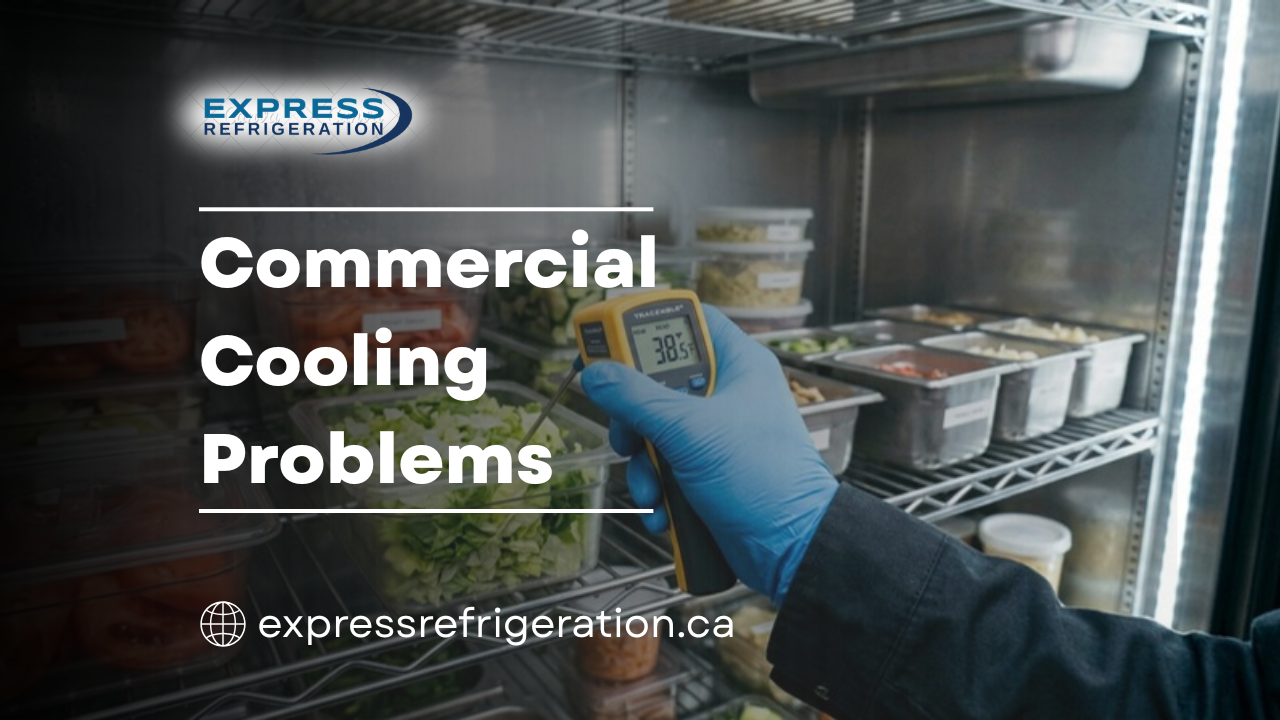
Practical tip: Use a calibrated probe thermometer to check actual food temperatures in your units every morning before service. Don’t rely solely on the unit’s built-in display — these can be miscalibrated and are not considered sufficient documentation on their own.
Temperature Logs: What Inspectors Expect to See
One of the most commonly cited refrigeration violations in Calgary food service inspections has nothing to do with the equipment itself. It’s missing or incomplete temperature records.
AHS inspectors expect to see a written temperature log for each refrigeration unit. That log needs to include:
- The date of each reading
- The time the reading was taken
- The temperature recorded
- The initials of the staff member who took the reading
- A notation for any corrective action taken if the temperature was out of range
A single logbook covering all units in the kitchen is not acceptable. Each unit needs its own dedicated record. Inspectors will flip back through your logs to see if temperature monitoring is happening consistently — not just on inspection day.
If your team has been skipping days, recording temperatures without actually checking, or using a shared sheet that doesn’t identify which unit was checked, these are flags that can result in a critical violation.
What to do if a temperature spike is documented: If your log shows a unit drifted above 4°C, you need to record what happened next. Did you check the food? Was anything discarded? Did you call for service? A spike with no follow-up notation is worse than a spike with documented corrective action. Inspectors understand that equipment occasionally has issues. What they want to see is that your team responded appropriately.
Common Refrigeration Violations AHS Inspectors Flag
Overstuffed Shelves Blocking Airflow
Walk-in coolers and reach-in fridges depend on consistent airflow to maintain even temperatures throughout the unit. When shelves are packed too tightly, cold air cannot circulate properly. The result is warm pockets inside the unit — areas where food may be sitting above 4°C even when the thermostat reads correctly.
Inspectors often catch this during a visual walk-through. If your shelves are crammed to the edges and the evaporator coils are buried behind product, expect a comment or a violation. Beyond the inspection risk, overstuffing accelerates wear on the compressor and leads to higher energy costs.
A simple rule: leave at least 5 to 7 centimetres of clearance around your evaporator coils and avoid blocking the return air vents inside the unit.
Improper Food Stacking and Cross-Contamination Risk
The order in which food is stored vertically inside a refrigeration unit is a critical food safety concern. Alberta’s food safety guidelines require raw proteins to be stored below ready-to-eat foods. Inspectors check this every time.
The correct stacking order from top to bottom is:
- Ready-to-eat foods (produce, cooked items, dairy)
- Whole fish
- Whole cuts of beef and pork
- Ground meats
- Raw poultry (chicken and turkey)
Raw chicken sitting on a shelf above uncovered salad greens is an automatic critical violation. This one costs restaurants in Calgary more reinspection time than almost anything else. Train your team on this during onboarding and review it regularly.
Water Pooling and Blocked Drain Lines
Standing water on the floor of a walk-in cooler or pooling inside a reach-in unit is more than a cleanliness issue — it’s a sign that your drain line is blocked or your evaporator is not defrosting properly. Inspectors interpret standing water as a potential contamination hazard and a maintenance failure.
Drain lines clog gradually. Debris, food particles, and mould build-up inside the drain pan and line until water has nowhere to go. By the time you notice pooling, the blockage has usually been developing for weeks.
Blocked drains can also trigger ice build-up on the evaporator coils, which reduces cooling efficiency and causes the unit to work harder to maintain temperature. If your walk-in cooler has been making unusual cycling noises or struggling to hold temperature, a blocked drain line is often part of the problem.
Scheduling regular maintenance — including drain line clearing — is the most reliable way to prevent this from showing up on an inspection report. If you’re not sure how often your units should be serviced, the answer for most Calgary commercial kitchens is at least twice a year.
What Happens When a Unit Fails During an Inspection
If an inspector measures the temperature of your refrigeration unit and it’s above 4°C at the time of the visit, they will typically:
- Record a critical violation on the inspection report
- Ask you to check the food and determine what needs to be discarded
- May require you to stop using the unit until it’s repaired and re-verified
- Schedule a reinspection to confirm the issue has been resolved
The cost of that scenario — in discarded product, potential permit conditions, and the labour of a reinspection — is almost always higher than the cost of proactive equipment maintenance.
If you need help getting a struggling unit back into compliance quickly, Express Refrigeration offers commercial refrigeration repair for Calgary food businesses, including same-day diagnostics for temperature and compressor issues.
Pre-Inspection Refrigeration Checklist for Calgary Restaurants
Use this checklist before every AHS inspection — and ideally, make it part of your weekly kitchen routine:
Temperature Documentation
- Each refrigeration unit has its own dedicated temperature log
- Logs include date, time, temperature, and staff initials for every reading
- Any temperature spikes are documented with corrective action noted
- Logs are accessible and organized for the past 30+ days
Equipment and Food Storage
- All units are holding at 4°C or below (verified with a calibrated probe thermometer)
- Shelves are not overstuffed — airflow is unobstructed around evaporator coils
- Food is stacked in correct order: raw poultry at the bottom, ready-to-eat at the top
- All food is covered and labelled with storage dates
Unit Condition
- No standing water or ice pooling on the floor or inside the unit
- Door gaskets are sealing properly — no visible gaps or tears
- Condenser coils have been cleaned within the last 6 months
- Drain lines are clear and draining properly
- Unit thermometers have been calibrated recently and display accurate readings
General Cleanliness
- Interior walls and shelves are clean and free of mould or debris
- Door handles are clean and functioning properly
- No raw product is stored directly on the floor of a walk-in
Calgary’s Climate and What It Means for Your Refrigeration Equipment
Calgary’s dramatic temperature swings — from -30°C winters to +30°C summer heat — put real stress on commercial refrigeration systems. Condensers working against extreme outdoor heat in July will run harder and wear out faster. Freezing temperatures near exterior walls can cause coils to behave differently than they do in moderate weather.
This matters for inspections because equipment that performed reliably all winter may begin to drift above temperature thresholds during a hot summer week — exactly when AHS inspection activity tends to be higher. If your rooftop units or exterior-mounted condensers haven’t been serviced recently, this is worth checking before summer fully arrives. The team at Express Refrigeration also handles rooftop unit service and replacement for Calgary commercial properties, which affects refrigeration system performance more than most operators realize.
When to Call a Refrigeration Technician Before Your Inspection
You don’t need to wait for an inspector to tell you something is wrong. These are the signals that a professional should look at your unit before you find yourself in a compliance situation:
- The unit is running constantly but struggling to hold 4°C
- You’re seeing more frost than usual on the evaporator coils
- There’s an unusual noise during compressor cycles
- Door gaskets are worn or not sealing properly
- Your temperature logs show regular spikes that resolve on their own
A refrigeration tune-up before inspection season typically includes a temperature calibration check, condenser coil cleaning, drain line clearing, refrigerant level review, and a gasket inspection. It’s the difference between walking into an AHS inspection with confidence and scrambling to explain why your walk-in was reading 7°C at 10 a.m.
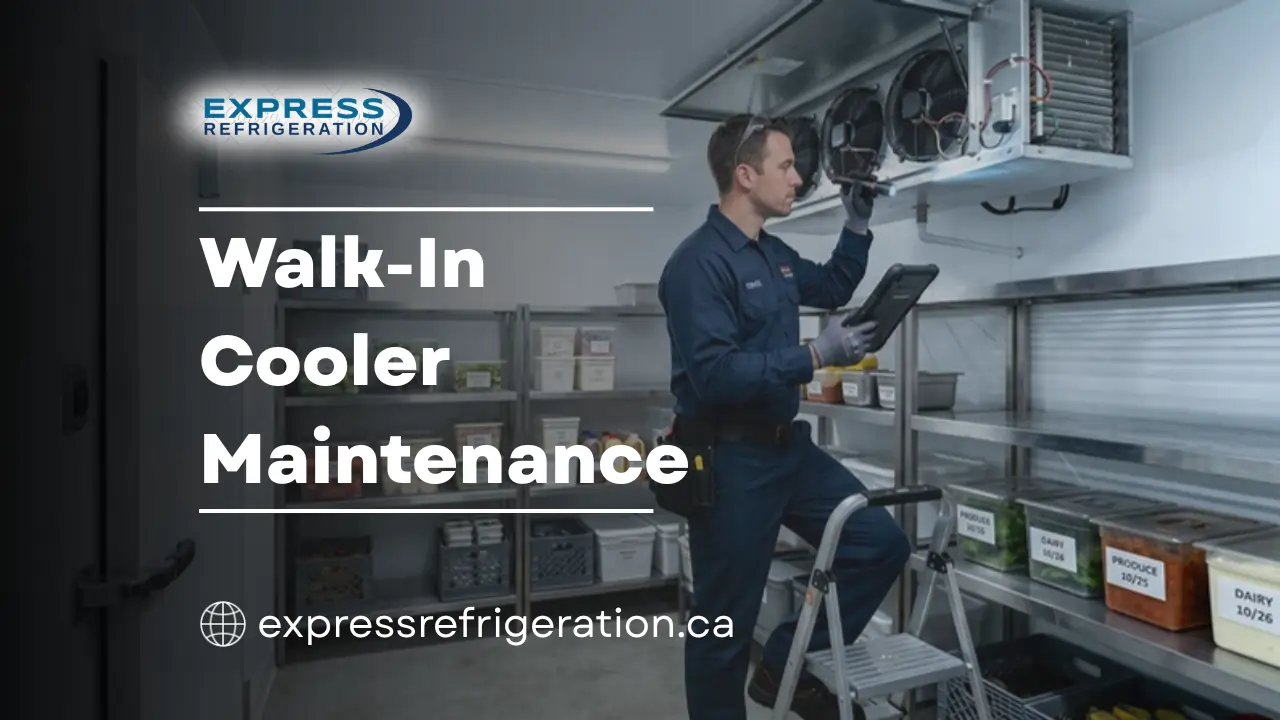
For more on what routine maintenance looks like and how often it should happen, take a look at our complete walk-in cooler maintenance guide — it covers service intervals, what technicians check, and how to build a maintenance schedule that keeps your equipment in compliance year-round.
Book a Pre-Inspection Refrigeration Tune-Up in Calgary
AHS inspections don’t wait for convenient timing, and a refrigeration violation doesn’t give you a second chance before it’s on your record. If your units are overdue for maintenance, your temperature logs aren’t consistent, or you’ve noticed anything off about your equipment’s performance, now is the right time to act.
The technicians at Express Refrigeration work with restaurants, delis, grocery operations, and commercial kitchens across Calgary. We diagnose and repair refrigeration equipment quickly, and we understand what AHS inspectors look for because we work with food service businesses every day.
Contact Express Refrigeration today to schedule a pre-inspection refrigeration service and head into your next health inspection with your equipment fully compliant and documented.